It’s human nature to look out for #1, but those who make this their life’s mantra are full of #2.
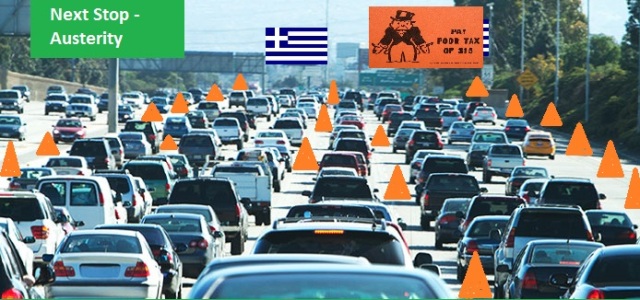
Last weekend I drove from my now-home in Illinois to my childhood home in Michigan for a quintessential 4th of July celebration. We enjoyed family, fireworks, barbecue, flags and patriotic songs. On the way back I experienced another American summer tradition: highway construction.
My wheels had barely kissed the pavement on I-94 in Southwest Michigan when traffic slowed to a stop. A sign warned that the left lane would be closing at an as-yet-unknown point ahead. This advance warning is supposed to give travelers who are in that lane ample time to move to the next in a gradual fashion – organically, if you will. That way there is little or no disruption to the flow of traffic.
Instead, that first sign acts as a signal for dip-wad drivers to move INTO the left lane. Then they can go as far as possible before merging into the right lane at the last millisecond. This means the rest of us idiots, who stayed in the right lane or moved over early, get to enjoy 5 miles of alternately surging forward and slamming on the brakes as we are forced to accommodate the a**holes nosing in at the front of the line.
I experienced this thrill-ride 5 or 6 times during the several hours I was trapped in construction zone hell.
I whiled away much of that time listening to a program on BBC radio about the Greek debt crisis. That crisis looms ever more ominously since the Greek people said overwhelmingly this week that they aren’t all that keen on austerity, and don’t want any more of it, thank you very much.
There are multiple layers of nuance in the Greek situation, of course, but as I understand it the basics are this: the government provides generous social welfare benefits for its citizens, mainly in retirement. Many people do not like paying taxes – no surprise. In Greece, however, skipping out on your taxes and getting away with it is part of the culture. Greeks retire earlier than those in many western countries and people in hazardous occupations, like hairdressers and trombone players, get to hang up their combs and spit-valves as early as age 50. Promising generous retirement terms is a sure-fire way for politicians to get elected when the voting majority is on the receiving end of benefits. As with most entitlement programs, citizens now feel, well, entitled to these benefits. The problem is that Greece can’t pay for them. Many pension funds are invested in sinking Greek debt so retirees are seeing their incomes shrink as well.
Even if someone pays into the retirement system for their entire working lives, those contributions cannot possibly cover what might be another 40 years of living without working. The job of supporting the retired falls to younger citizens and immigrants. There aren’t enough of those workers, nor are there enough good jobs for them to carry the burden.
America has just such a Ponzi scheme, called Social Security, but our retiree-to-worker ratio is better, our retirement terms aren’t quite as generous, and we have a relatively healthy economy so we’re in better shape – so far. The Greek economy is on life support.
The Greek government has been borrowing to provide the promised benefits and the time has come to pay the piper, which are European banks and the International Monetary Fund. Greece doesn’t have the money.
When you look at the question on a personal level, most people would agree that someone who borrows money should pay it back. If you loaned me $100 you would expect me to make good on my promise to pay you back, wouldn’t you? Even if it wasn’t easy for me, and I had to eat Ramen noodles for a year to do so? Because it is YOUR money, not mine.
The ethics seem to be a little murkier when it is a group who owes the money. An individual might understand and agree with the theory, but when it hurts them personally the response is: no way. Let someone else in the group pay that piper. This response becomes easier to justify when the creditors have been neatly and conveniently demonized as rich, fat-cat bankers. Never mind that the money that was lent to Greece doesn’t come from the pockets of some Monopoly guy in a silk top hat. It comes from all of the little you’s-and-me’s who paid their taxes and/or deposited their money in those banks who made the loans. They…we…are the poor suckers who follow the rules and end up stuck in the right lane of life.
I really feel for the Greek people. I do. How horrible to see your income shrinking, to have the banks closed so you can’t withdraw your own money. I’m at the age where I would be looking longingly toward retirement if I lived in Athens. To think of that brass ring being pulled back just as you were reaching for it, or to have to go back to work when you’ve been living the life of leisure for years would be tough. Incredibly tough. But what is the alternative? Who else should pay for the benefits that Greece promised its people and can’t afford to provide?
This sounds much like the situation we have with our public sector employees in the soon-to-be-Greek state of Illinois.
I don’t know the best answer for Greece. I don’t see any way around the hard truth that they will have to bear a heavy burden as a result of bad luck and worse choices. At the same time, it seems clear that if decisions on how to handle this crisis are up to the majority vote, they will not choose to make things tougher on themselves.
Which brings me back to the scene of my cogitations about all this – stuck in construction traffic on I-94. Anyone with half a brain knows that merging early and gradually is the best solution for all travelers as a group. If everyone gives up a couple minutes of travel time, all will get where they’re going more smoothly. Waiting until the last possible second, however, is better for that individual, jerk-wad driver. He chooses that path because he will get to his destination 10 minutes earlier, so to hell with the rest of the herd.
The bottom line for both the Greek debt crisis and highway construction traffic is the reason why Communism sounds good in theory but never works in practice. “People,” as individuals, tend to be generous, especially if they know the recipient, or can see them, face to face. “People” in general, however, especially when they can be anonymous, tend to look out for #1 above all else.


 Don’t do the crime if you can’t…pull an all-nighter for your English 101 final.









 Peg-o-Leg's Ramblings